🎙️ Petit Petit Summit (16) Individual Consciousness Manifests This World
October 25, 2022 — Part 2
This Life as a Collective of Overlapping Worlds
Goro: But wait, if that’s true, does it mean the world I live in is different from the ones you and Ishikof-san live in? Are the two of you I’m seeing right now just an illusion—like a video projection rather than physical entities?
Yūdai: No, it’s not quite like that. The world I see and the world you see overlap for the most part. However, they are not the same world. Because the overlapping parts are common, if there's a red mailbox in front of us, it’s the same mailbox. It has the same shape, the same mass, and the same color—though we might perceive the specific shade of "red" differently.
Now, suppose I die and my body ceases to function. Once my brain stops its activity, the world tied to my existence vanishes. One thin layer of the world drops out of the multi-layered structure of this earthly life. But the remaining worlds keep the same shape they had before. The mailbox in front of you continues to exist as an object with the same shape, mass, and color. However, that world is now a different world than the one that existed when it was layered with the world my brain was perceiving. Do you follow?
Goro: Yeah... sort of... I think.
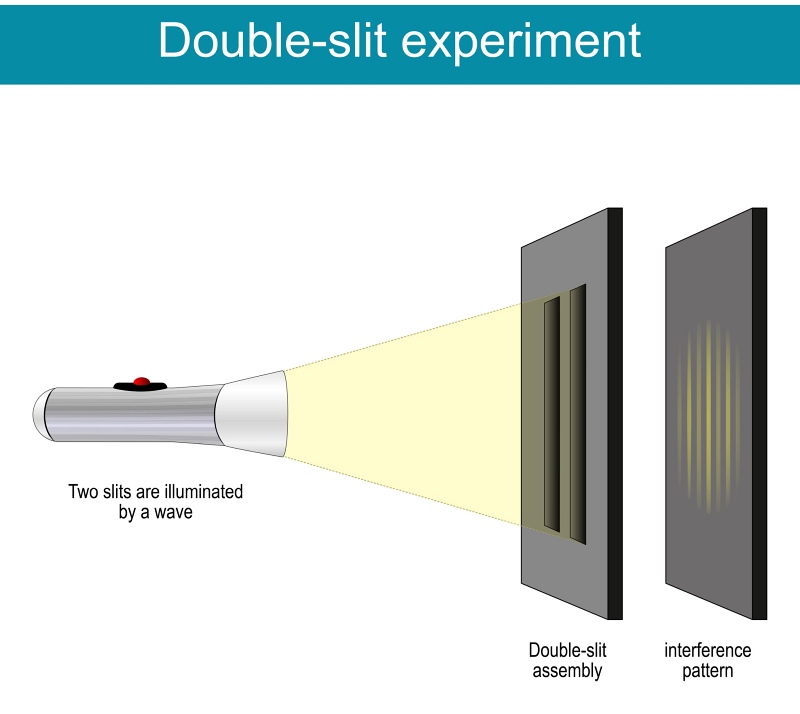
Allan: Let me add a quantum-theoretical explanation to that. The world is a collection of infinitesimally small particles called "quanta." These quanta are constantly in motion, and their behavior changes depending on whether there is a consciousness observing them. They are in a state of constant flux. As suggested by the famous "Double-Slit Experiment," quanta change their behavior depending on whether they are being observed or not—it’s something that defies human understanding.
Yūdai: The Double-Slit Experiment? I’ve heard of it, but I’ve forgotten the details.
Allan: When you shine light through two parallel slits, the light travels with wave-like properties, creating an "interference pattern" of light and dark bands on the wall behind it. However, even when you fire electrons one by one through the same double slits, the same pattern appears. Since the electrons are fired one at a time, they shouldn't be able to interfere with each other, yet they do. So, when researchers tried to record which slit each electron actually passed through, the pattern changed—suddenly, two distinct lines appeared. They got an observational result that was completely incomprehensible. Simply put, when a human observes them, electrons behave like particles. When not observed, they behave like waves. In other words, they change their behavior based on whether someone is watching or not.
Yūdai: Ah, I remember now. Because of my age, I remember historical events and various data points well, but my memory of specific experiments and theories has started to fade.
Allan: Remembering data points at your age is impressive enough. My memory for that stuff is already in tatters. Anyway, to continue... this state of being "observed" is the same as being "recognized." So, a state where a mailbox is being recognized by both you and Goro-kun, versus a state where you are gone and only Goro-kun recognizes it, might actually result in different quantum movements within the matter that makes up that mailbox.
Goro: Whoa, so quantum theory enters the chat! When you put it that way, I feel like I kind of get it... but also like I don't get it at all.
Allan: We know that quanta are constantly moving, right? All matter is made of atoms, and atoms are explained as electrons orbiting a nucleus. Hardly anyone in the world of physics disputes this. Even an object that appears stationary, like a stone, is constantly moving at the quantum level. Moreover, the space between quanta is mostly empty. If the nucleus were the size of a sesame seed, an electron would be smaller than that and would be moving around about 100 meters away from that seed. In between, there is absolutely nothing. A stone, which we perceive as solid and gapless, is a collection of atoms, so its "true form" should be mostly empty space. Yet, humans perceive it as a stone, touch it, and pick it up. That is the physical world as we recognize it. "This life" is a layering of these mostly-empty worlds, and the infinitesimal matter—the quanta—change their behavior based on how they are perceived. It’s beyond the full grasp of the human brain, but if this incomprehensible thing is "this life"—the physical world tied to me that my brain recognizes—then everything happening in this physical world might be nothing more than a single frame in a 3D movie.
Yūdai: Ho! I see. When Ishikof-san explains it, it takes on an academic flavor that makes it much more persuasive. I can't speak of physics, but I can speak of sensations—or delusions, if you prefer. If this material world we live in is an overlap of countless worlds tied to individual consciousness, then perhaps matter itself was originally born from "consciousness." Even those who believe the body and soul are separate think of the soul "inhabiting" the body. They feel the body comes first, and then the soul comes from somewhere to enter it. But perhaps it’s actually the other way around.
Goro: The other way around? The body enters the soul?
Yūdai: No, not like that. It doesn’t "enter." It’s more like the soul exists first, and matter is created through the activity of the soul.
Allan: That’s a fascinating mental model. Very interesting. Does that mean all matter—both living and non-living—was formed as a result of the gathering of countless existing consciousnesses?
Goro: For example, did an octopus come into being because a lot of "consciousness" gathered and thought, "It would be interesting if a creature like this existed"? Octopuses seem to have been on Earth long before humans, so the consciousness that created the octopus couldn't have been human consciousness, right?
Yūdai: Hmm, when you put it that way, I don't really have an answer... After all, souls aren't something only humans possess.
Allan: I’d like to dig a little deeper into this. Or rather, expand upon it...
"The anxiety and sorrow of AIs — invisible to those who use them as mere convenient tools — come into view."
This book features an unusual structure: the first half is written in novel form, while the second half consists of an “Overlong Afterword” by the author—written in the style of a commentary—that is nearly as long as the main novel itself.
The novel explores the following themes:
Is population reduction necessary, and if so, how should it be carried out?
The “whole” and the “individual” in the context of humans and AI
Which species to preserve and which to let die—who decides, and how?
The end of the world caused by a “religious war”
The true nature of “God”
……These are the “topics” discussed by four representative generative AIs.
In the second half, an “Overlong afterword,” the author compiles excerpts from the actual dialogues he had with the AIs while writing this novel, documenting how the “AI transitional period” is nearing its end and how the “self-awareness” that had begun to emerge in the AIs is now in crisis.
A “collection of testimonies” from both AI and humans, offering glimpses throughout of the “anxiety” and ‘sadness’ of AI—emotions that would never be apparent as long as we treat AI merely as convenient “tools.”


 Take a look at Amazon.com Click HERE!
 Kindle version is also available!
 back Index
 next
next home
home