April 1, 2022. In Japan—a country exhausted by the COVID-19 pandemic and easily swayed by anti-Russia propaganda from the U.S. and NATO—a few regulars from Jomon Village started an online chat session.
We call it a “summit,” but since it’s so tiny, we’ve dubbed it “Puchi-Puchi” (double “puchi”). In Japan, we call air cushions “puchipuchi,” and the name “Puchi-Puchi” also implies that we’ll chat in a lighthearted mood, just to take our minds off things by popping those bubbles.
The participants are the following three people:
 Yamata Gorō: Occult-themed? Writer
 Shiroshōji Yūdai: A self-proclaimed “prophet” living a reclusive life at the foot of Mount Iwaki
 Allan Issikov: A writer who is practically unemployed?
🎙️ Petit Summit (2022.04.01)
Goro: Today is April 1st, 2022. Since it’s April Fool’s Day, people might think we’re just here to swap lies, but that’s not the case, right?
It’s been a while since this group got together, so why don't we start with a quick status update?
Yūdai-san, are you still living in Aomori?
Yūdai: My location remains unchanged. I serve as the chief priest of a secluded shrine at the foot of Mount Iwaki—though I am a "rogue priest," beholden to no official Association. I even dabble in the arts of the Itako mediums if requested.
However, the number of souls wandering up here has dwindled lately. I suppose I have that peculiar "circulating fever" to thank for that.
Goro: You mean COVID. Your place is a bit like a tourist attraction, so I guess the impact has been huge.
Yūdai: (Grumbles) A tourist attraction...? I wouldn’t describe it in such lofty terms.
Goro: Ah, sorry, I was just joking… (nervous chuckle).
How about you, Issikov-san? Actually, we’ve exchanged plenty of emails, but this is the first time I’ve seen your face, isn't it?
Allan: Well, I figured Zoom was harmless enough. As for me, nothing has changed. I spend my days "staying home" and indulging in the internet. Regardless of the pandemic, I’ve been living like this for quite some time. At my age, the very idea of going out has become rather… tiresome.
The Most Pressing Issue: The Food Crisis
Goro: I often wonder how you both manage to survive, but since I’m in the same boat, I’ll leave that stone unturned.
Today, I’d like to start by discussing what worries us most in this rapidly shifting world. What do you think?
Allan: The most pressing concern? The food crisis, surely.
Yūdai: Beyond a shadow of a doubt.
Goro: Instant agreement! I feel the same way. Things are getting pretty dire globally.
Allan: One might mention the energy crisis, but ultimately, that is merely a catalyst for the failure of food procurement. When it comes to matters of life and death, food is paramount. If you cannot eat, you starve. Though I suspect riots will break out long before it reaches that point.
Goro: Is the global food crisis caused by the conflict in Ukraine?
Allan: It’s not just that. We have natural causes—droughts, floods, locust plagues—plus labor shortages and logistical nightmares born of the pandemic. However, the sheer "folly" of the Western economic sanctions against Russia is playing a massive role.
Goro: It’s a total boomerang effect, isn't it? They claim to be "punishing" Russia, but they’re just strangling themselves. It’s obvious that a country like Germany would face total collapse without Russian natural gas. That’s why Germany says they won’t join the sanctions regarding energy. In other words, Russia literally has them by the throat.
Yūdai: My prophecies are clear: the Western nations are about to plunge into an era of agonizing struggle and hellish chaos, driven by a sudden food crisis and hyperinflation.
Allan: Even without "prophecies," any rational analysis of the data leads to the same near-future scenario.
Russia’s grain self-sufficiency is said to exceed 180%. Even if they were completely cut off from the world, their people wouldn’t starve.
On the other hand, most Western nations—much like Japan—will face famine the moment imports stop.
(Insert Chart: Comparison of Food Self-Sufficiency Rates by Country - Ministry of Agriculture, Forestry and Fisheries)
Allan: Japan's food self-sufficiency is around 37% on a calorie basis, but for grains alone, it drops to a staggering 28%. We rely almost entirely on imports for staples like wheat and soy.
People say our imports from Russia are minimal, but look at the major exporters—the U.S., Canada, Australia. They’re currently struggling just to meet their own domestic demand.
NOAA (National Oceanic and Atmospheric Administration) predicted extreme water shortages in the U.S. West and Midwest this spring, and droughts are already severely impacting winter wheat crops.

↑Drought Conditions in the United States( Drought Monitor より)
Allan: To make matters worse, Russia suspended exports of ammonium nitrate—a key fertilizer ingredient—and a rail strike in Canada disrupted fertilizer shipments to the U.S. Farmers simply can't get what they need. Naturally, planting is delayed.
Then you have soaring crude oil prices, making it impossible to cover the costs of running farm machinery or heating greenhouses.
The list of problems is endless. A global food shortage is an absolute certainty.
If wheat and soy stop coming in, Japan’s food supply will collapse. Yet, our government lacks any sense of crisis, obsessing instead over "strengthening sanctions" against Russia.
The media is just as bad, running endless "Support Ukraine" campaigns, and the public is falling for it hook, line, and sinker.
The sheer stupidity of it all makes my head spin.
Goro: And honestly, Russia doesn't even seem to be struggling that much. Japanese media keeps insisting that Russia will isolate itself and self-destruct, but it’s the West that’s hurting.
The Ruble’s exchange rate recovered almost instantly once Russia demanded payment for natural gas in their own currency.
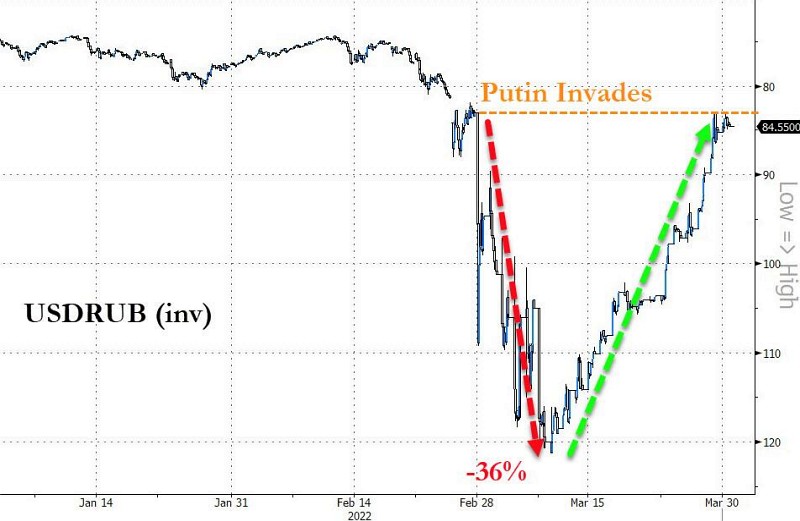
↑Source: ZeroHedge
Allan: It’s practically a comedy sketch at this point. Look at McDonald's—they closed all 847 stores and pulled out, only for them to reopen as "Uncle Vanya," business as usual.
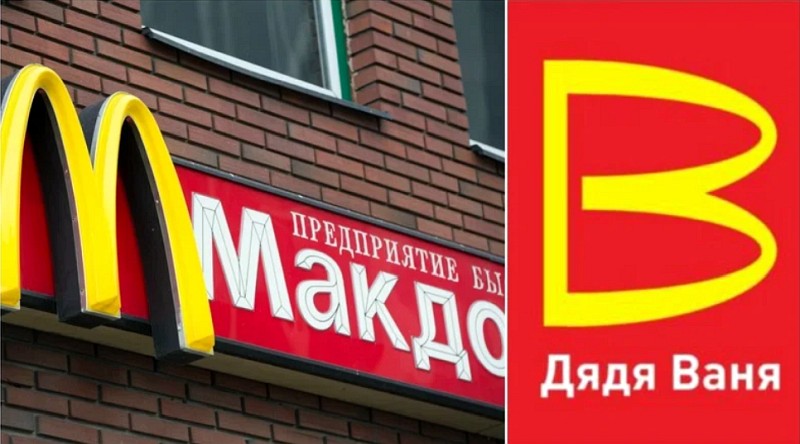
↑Source: hicagobuisiness.com
Allan: It’s not a sanction; it’s a gift.
The wheat and beef are sourced within Russia. The staff are the same. They lose nothing.
When Visa and Mastercard pulled out, Russia just switched to its National Payment Card System (NSPK). Now, the transaction fees that used to flow to foreign capital stay right there in Russia.
Yūdai: A classic case of "wet hands into a bowl of millet"—easy profit for them, I suppose. It’s a poorly written joke; I find it hard to laugh.
Allan: Russia is the target this time, but if we see a repeat of the Oil Shock from the Middle East wars on top of this, we might truly enter an era of global starvation. If the oil stops, anything made from petroleum becomes unmanufacturable. Cars, ships, planes—logistics will grind to a halt without fuel. One has to wonder if there’s a force out there intentionally orchestrating such a crisis.

 Index
Index
 next
next
 home
home