Allan: Before we talk about a new political and economic sphere centered on Russia and China, can you predict what lies just a few months ahead?
Yūdai: My prophecies and intuitions rarely reveal precise timing. A few months from now... you mean the latter half of 2022? Within that range, I suspect you two, with your access to information, see it more clearly than I do.
Goro: Because of my job, I often meet and talk with people from various industries—people active on the front lines. Since the start of this year, everyone has been saying the same thing: "Japan is about to fall into a desperate predicament."
Yūdai: In what way?
Goro: Basically, everything will become difficult to obtain, and prices will skyrocket.
Yūdai: And food will be the primary example, I presume? As we discussed at the start.
Allan: No doubt about it. Right now, prices have simply gone up; items haven't vanished from the shelves yet. But soon, I suspect certain things will stop appearing in stores altogether.
Back during 3.11, shelves were emptied, but that was just temporary panic-buying. This time, the products might truly stop arriving. By autumn, the reality will be undeniable.
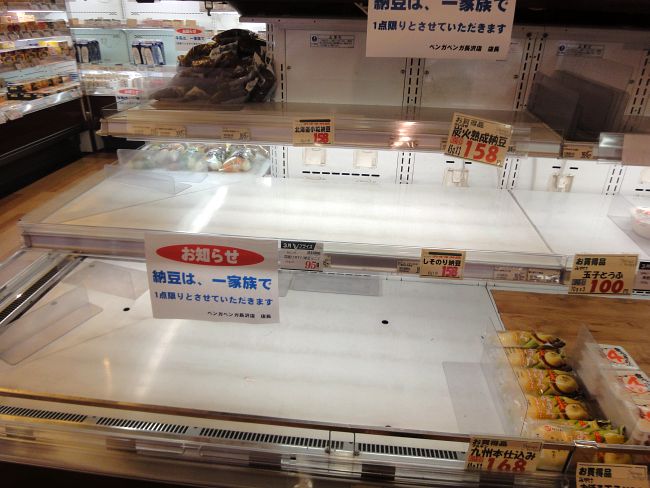
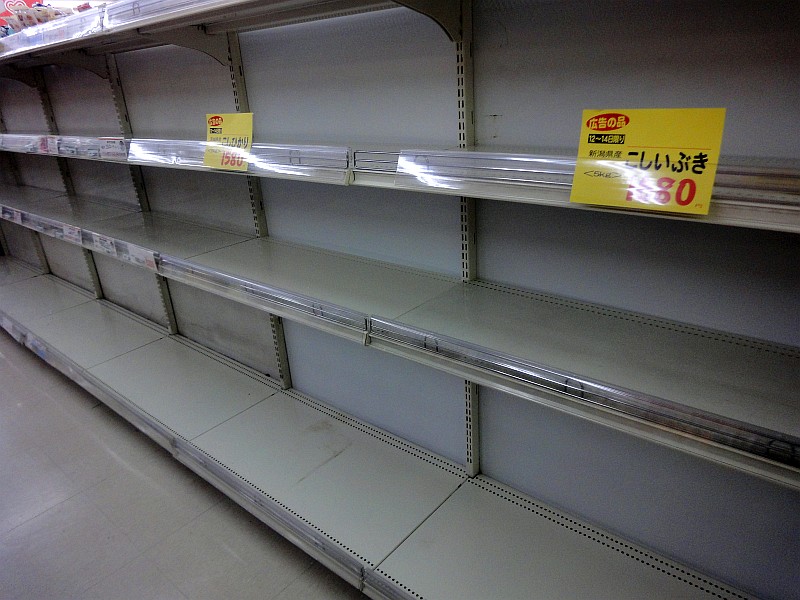
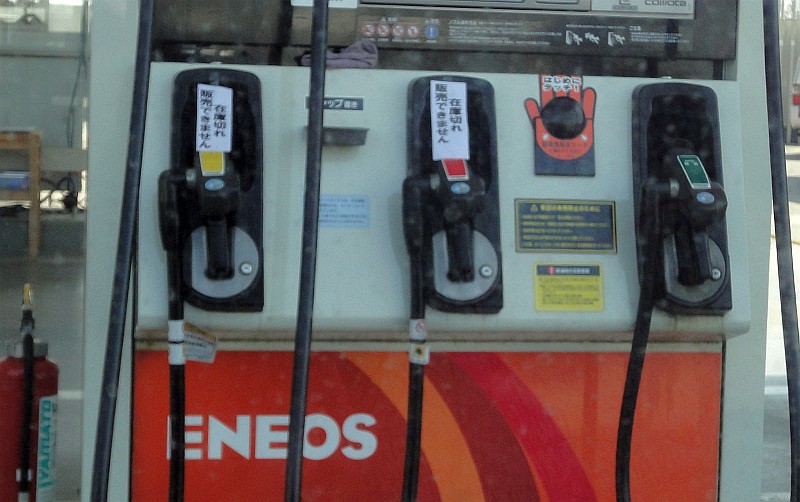
(Images: Supermarkets and gas stations in March 2011)
Goro: How should those of us who aren't food producers deal with this?
Allan: There’s a limit to stockpiling. You can store canned goods, but perishables like meat and vegetables are out of the question. Even rice doesn't last long unless the white grains are refrigerated.
Goro: I was talking to a farmer involved in circular agriculture recently. He said that the self-proclaimed "minimalists" and "ecologists" living in the city won't survive.
Yūdai: Mini-what?
Goro: Minimalists. People who try to live with as few possessions as possible. No extra furniture or knick-knacks; just the bare essentials for tools and clothing. It's a lifestyle trend often featured in the media—the idea that you can live comfortably in a tiny room if it's empty.
Yūdai: That sounds like a noble endeavor to me.
Goro: Well, it might be fine in theory, but from a farmer's perspective, that lifestyle is only possible because goods are currently abundant.
You have a convenience store nearby where you can buy food in the middle of the night. Anything you need can be ordered online and delivered to your door. You can only afford to say "I don't need things" because the world is too convenient. The moment products vanish from stores and logistics stop due to fuel costs, they'll starve instantly.
Yūdai: I see. That makes sense. They have no warehouse to store food, and no alternative plan for when the electricity or gas is cut off.
Goro: It's the same for the city "ecologists" who carry their own bags and chopsticks to avoid plastic waste. Many of them have no idea how to actually utilize those items effectively.
A farmer looks at a disposable chopstick and sees kindling, or a skewer if you sharpen it with a knife. A plastic bag can be used as a bucket if you layer them.
People who have never used a saw or a hammer, who don't own a screwdriver, or who have never even looked under the hood of a car... it’s hard to imagine them overcoming the coming energy and food crises.
Allan: Indeed. A farmer has to be a jack-of-all-trades. Repairing buildings, fixing tools, processing the harvest, maintaining vehicles—it's all part of the job.
Yūdai: It’s not just farmers. Truckers, sailors, loggers... they all possess the fundamental skills for survival.
Allan: This might be a slight tangent, but when the Fukushima Daiichi plant (1F) exploded, the staff in the pitch-black control room tried to keep the instruments running by gathering batteries from the cars in the parking lot. It sounds like something out of a manga, but it actually happened.
While it’s appalling that a nuclear plant reached such a state, even in daily life, you have to ask: "What do I do if the power, gas, and water are out for a long time?" If you live a life with "nothing" at hand, there is no way to cope. You’d have no choice but to wander out of the city in search of food and a place to sleep.
Yūdai: But surely that "Mini-whatever" lifestyle is good for when you're fleeing with nothing but the clothes on your back? You're light and mobile.
Goro: True, if your house is full of furniture and hobbies, it’s hard to make the decision to leave. But you can't eat "mobility." If you stay in the city, you'll starve.
Food is the biggest concern, but other things are becoming scarce too. Construction materials, housing equipment, semiconductors, metals—the fundamental parts of every industry are already hard to find.
When I interviewed a local contractor, he said that even if he gets orders for new houses or renovations, he can't finish the work because he can't get the materials.
A house might be finished, but he can't hand it over because there’s no toilet, or he can't install a water heater.
One guy told me that since manufacturers have no stock, he searched Yahoo Auctions and Mercari. When he finally found what he needed, the seller wouldn't ship it—it was "pickup only"—so he had to drive a huge distance to get it.
Allan: In the past, these issues would resolve themselves within a month. This time, I'm not so sure. I have a feeling things will only worsen.
If we don't play nice with Russia, food and energy won't come in. If we don't play nice with China, rare metals and semiconductor parts won't come in. Japan calls itself an industrial nation, but we have to source our materials from abroad, and our processing and quality are no longer leaps and bounds ahead of other countries. In many fields, we’ve already been overtaken. Look at home appliances; hardly any major brand products are made domestically anymore.
Goro: Look at Toshiba. The brand remains, but the entity is basically a Chinese company. Their TV business was bought by the Hisense Group five years ago. Only the "Toshiba REGZA" brand survives.
And it’s not like the quality dropped once it became a "Chinese Toshiba TV." If anything, the production lines became more efficient and the cost-performance improved. It makes you wonder if Japan can really still call itself an industrial nation.
Allan: Japan has clung to the U.S. for so long that we’ve lost the strength of the "Japan Brand" over the last few decades. I wonder how other countries see us now.
The 100-yen shops were supported by Chinese cottage industries and small factories, but now there’s no profit in making things for Japanese 100-yen shops, so they’re switching to exports for Europe and the U.S. In those countries, 100-yen items are sold for two or three times the price. Meanwhile, in Japan, many people are so poor they couldn't afford a 100-yen item if it became 200 or 300 yen. The reality is that China keeps sending products out of a sense of pity—a "charity export" because they’ve known us for a long time and don't want us to suffer.
"If we don't sell to them, the poor Japanese will be in trouble." I feel the same is true for food and energy resources. But eventually, when supplies run low, we will be the first to be cut off.
In terms of food imports, countries in Africa and Southeast Asia will likely face severe famine first, but I suspect Japan will be next in line.
Yūdai: Famine... most Japanese people today can't even imagine it. Yet, it was common in the Edo period.
The population now is far larger, and we have no food self-sufficiency. If the food stops coming from outside, it will be a living hell.
Goro: Man, this got gloomy fast. It’s a pretty blunt way to end this, but let’s call it a day for now. I actually have to go do some shopping...
Allan: Right. See you later.
Yūdai: Stay well.


 back
back
 next
next home
home